

Signs You’re Losing Visceral Fat
Video | Visceral vs. Subcutaneous Fat | Hard Belly | Waist Circumference | Inflammatory Markers | Blood Pressure
Visceral fat accumulates deep inside the body and surrounds the abdominal organs. You can’t see it or pinch it, so how do you know it’s there, and how do you know if the healthy lifestyle actions you are taking are making it go away?
Yes, you can gain insights from a measuring tape, but where is the best place to measure, and are there more accurate signs that you are losing this dangerous, pro-inflammatory fat?
In this blog post, I share easy-to-test markers and what science has concluded is the best location on your waist to measure.
Signs of Visceral Fat Loss – At-A-Glance
- Visceral fat lies deep in the abdomen. It surrounds vital organs and releases inflammatory compounds.
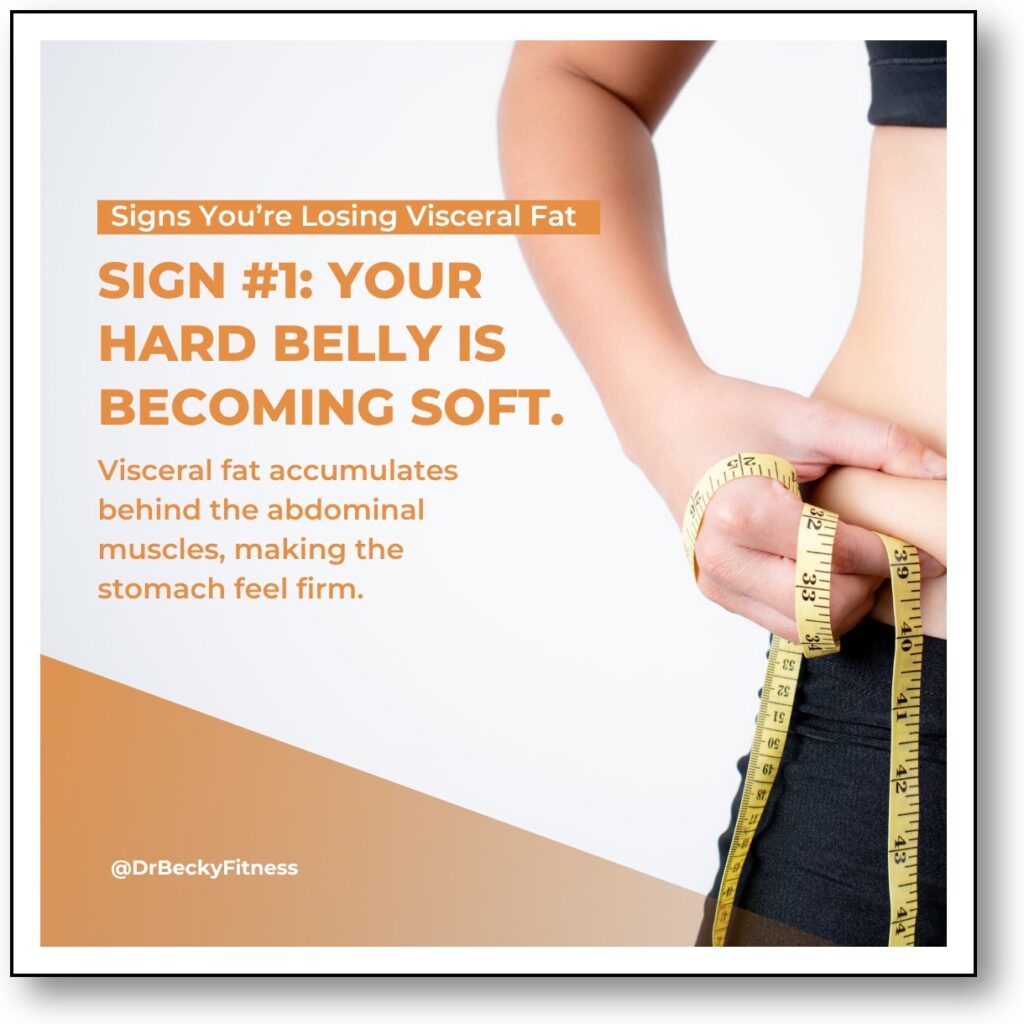
- Sign #1: Your Hard Belly is Becoming Soft. Visceral fat accumulates behind the abdominal muscles, making the stomach feel firm.
- Sign #2: Your Waist Circumference Shrinks. Measuring the waist at the midline between the lowest rib and iliac crest (top of the hip bone) is the most accurate measure of visceral fat.
- Sign #3: Reduced Inflammatory Markers. A blood test called high-sensitivity C-reactive protein (hs-CRP) measures inflammation in your body.
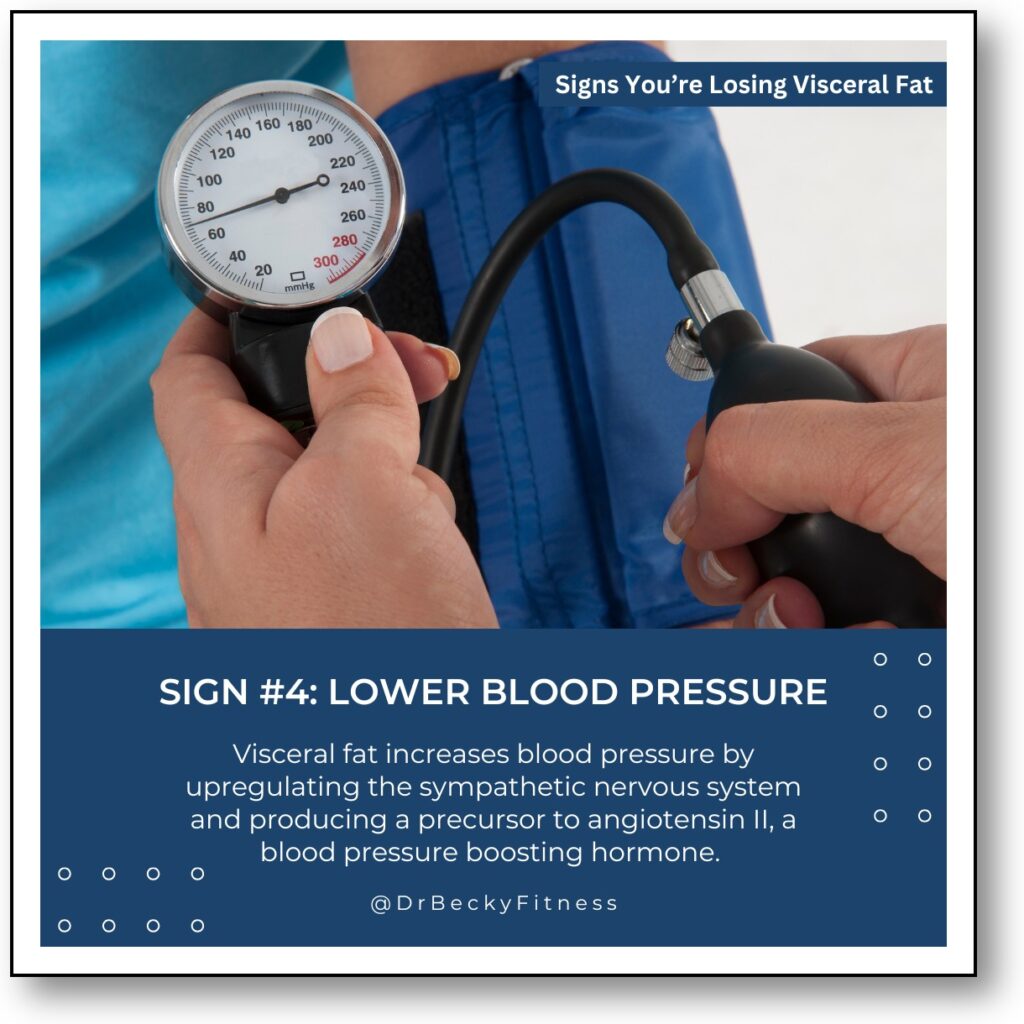
- Sign #4: Lower Blood Pressure. Visceral fat increases blood pressure by upregulating the sympathetic nervous system and producing a precursor to angiotensin II, a blood pressure boosting hormone.
Signs You’re Losing Visceral Fat [Video]
In this video, you’ll learn…
- The difference between visceral fat and subcutaneous fat.
- Four ways to know if you’re losing visceral fat.
- Tips and tools to help you measure properly.
Visceral Fat vs. Subcutaneous Fat
We tend to refer to visceral fat as belly fat, and it is, but it is only part of the equation. The measurement that you make around your waist is made up of both visceral fat and subcutaneous fat. Visceral fat is deep inside, behind the abdominal muscles. Subcutaneous fat is outside of the muscle wall. This brings us to our first sign, which has to do with the hardness of your belly.
Sign #1: Your Hard Belly is Becoming Soft
The first sign that you are losing visceral fat is that your previously hard-to-the-touch belly is getting softer. If you’ve ever wondered why some people have large bellies that are as hard as a rock while others have large, soft bellies, it often has to do with the type of fat they carry.
While belly firmness is not a perfect diagnostic tool for an overweight individual, a hard belly often indicates a higher amount of deeply stored visceral fat. This fat pushes against the abdominal wall, making the stomach feel firm or tight.
A soft belly is usually the result of more subcutaneous fat, which sits just under the skin and outside the abdominal muscles.
Sign #2: Your Waist Circumference Shrinks
How big of a belly is too big? A study on visceral fat shared that men with a waist circumference greater than 40 inches and women with a waist circumference greater than 35 inches are at increased risk for metabolic diseases (1).
This gives us both a goal to hit and our next sign that you’re losing visceral fat, namely, your waist circumference shrinks.
When you take a waist measurement, the result is the sum total of both types of fat: visceral and subcutaneous. Even though using a tape measure is a simple and inexpensive option, you may be left wondering which type of fat you are losing.

Fortunately, there is good reason to assume that if your waist measurement is decreasing, you are losing the dangerous visceral fat.
We see from research that when you lose weight, there is a higher turnover of visceral fatty cells in comparison to subcutaneous fat cells (2).
If your waist is shrinking, you are most likely losing visceral fat. But here’s the problem. Where do you measure?
Where to Measure Your Waist
If you have ever wrapped a tape measure around your midsection and wondered where exactly to measure, you can thank the research team I just mentioned for providing an answer.
They reviewed 11 observational studies, comprising more than 8,500 participants, and found that measuring the waist at the midline between the lowest rib and iliac crest, or the top of the hip bone, was the most accurate measure of visceral fat and percentage body fat in both sexes (2).
Take your measurement at that level and watch for it to decrease.
I will add that you can measure your waist-to-hip ratio as well as your waist-to-height ratio.
Waist-to-Hip Ratio
- Divide your waist size by your hip size at the widest part
- A ratio above 0.85 (women) or 0.90 (men) signals excess visceral fat.
Waist-to-Height Ratio
- Divide your waist size by your height.
- A healthy ratio is no greater than 0.5 (in men and women)
However, the research was mixed about whether these methods are more accurate for predicting visceral fat than simply measuring the waist, so for simplicity’s sake, the single waist measurement will work.
Here are a couple of tips to help with measuring:
Tip #1: Measuring Tape:
Consider investing a few dollars in a body measuring tape with a lock pin and push-button retraction. This will help you with your accuracy because it retracts to the same tightness each time. You can find them on Amazon.
Tip #2: Visceral Fat Calculator:
If you are going to gather your measurements anyway, consider using this free Visceral Fat Calculator.
This one gives you a numerical score to see where you rank toward visceral obesity, and you can reenter your data as your health improves to watch your progress.
Sign #3: Reduced Inflammatory Markers (lower hs-CRP)
The two types of fat that accumulate in the abdomen are very different. Subcutaneous fat affects the body’s shape but is less harmful to health than the deeper visceral fat. Having too much of that internal fat is a problem because it surrounds vital organs and releases inflammatory compounds.
Inflammation is the bubbling lava under the surface that is waiting to erupt. In other words, you don’t notice its effects until it’s too late and it causes the onset of heart disease, diabetes, and other metabolic disorders.

When you lose visceral fat, inflammation decreases. A blood test called high-sensitivity C-reactive protein (hs-CRP) can measure your body’s inflammation level.
If you’ve never had this blood test done before, you can do it now to establish a baseline, then retest after a few months of diet and exercise to see if it is improving. Each lab has a different range for what’s normal, and will share that range with you, but what you are really looking for is your hs-CRP level to decrease over time.
Sign #4: Lower Blood Pressure
General weight gain is associated with high blood pressure, but visceral fat, in particular, may be to blame.
Visceral fat can contribute to upregulation of the sympathetic nervous system. We think of this part of the system as the fight or flight side because it increases heart rate, constricts blood vessels, and raises blood pressure.
Visceral fat also produces a precursor to angiotensin II. This hormone raises blood pressure in two ways. First, it causes the muscular walls of small arteries (arterioles) to constrict or narrow. Second, it triggers the release of aldosterone and ADH, which are additional blood pressure boosting hormones.
Tools for Measuring Visceral Fat
I want to touch on tools to measure visceral fat. Accurately measuring this deep-lying fat can be done, but it is not easy or inexpensive because it requires a CT, MRI, or DEXA Scan.
There are body composition scales that you can buy for home use that use bioelectrical impedance analysis to estimate body fat, and often visceral fat, levels. While not as accurate as medical scans, they are helpful for tracking trends over time.
Takeaway
In this post, we discussed four signs that you are losing visceral fat. If you notice that your once hard belly is softer, you’re likely losing visceral fat. If your waist measurement, taken midway between your lowest rib and the top of your hip bone (iliac crest), is decreasing, you are losing visceral fat because it is the first to go.
Because this deep, internal fat increases inflammation and blood pressure, seeing a reduction in your hs-CRP level and blood pressure indicates that you are on the right track.
References:
(1) Klein, Samuel. “The case of visceral fat: argument for the defense.” The Journal of clinical investigation 113.11 (2004): 1530-1532.
(2) Shi, Wendan, Lis Neubeck, and Robyn Gallagher. “Measurement matters: A systematic review of waist measurement sites for determining central adiposity.” Collegian 24.5 (2017): 513-523.
About the Author
Becky Gillaspy, DC, is the author of The Intermittent Fasting Guide and Cookbook and Zero Sugar / One Month. She graduated Summa Cum Laude with research honors from Palmer College of Chiropractic in 1991.


